
Coloring Outside the Lines: A Celebration of Creativity
Questions? Contact: Tyler Hill, Library Research Assistant | tyler.hill@usu.edu
Looking for a little creative inspiration? Browse our curated list of great reads to help you feel inspired this winter!
Check out our Resources for Creativity guide!
From ebooks to quilt making, computer programming to fashion, this guide is designed to help you explore your own creativity!

Read January’s Libby Book of the Month!
The Ghostwriter by Julie Clark is this month’s featured e-book—and it’s available to everyone with no holds or wait times through the Libby app.
June 1975. A night that changed everything.
When two teenage siblings are found dead in their home, the whispers begin—and they never stop. Their brother, Vincent Taylor, survives the night but never escapes suspicion. Decades later, he’s become a famous horror novelist. But now, he’s ready to reveal the truth.
Ghostwriter Olivia Dumont, his estranged daughter, has one chance to save her finances—by writing his final book. What she doesn’t know is that her father’s not after fiction this time. He’s ready to talk about what really happened.
This gripping literary thriller explores the weight of memory, the power of storytelling, and the secrets we carry. Start your year with a read you won’t be able to put down.

Music is History by Questlove and Ben Greenman
Questlove finds the hidden connections in the American tapestry, whether investigating how the blaxploitation era reshaped Black identity or considering the way disco took an assembly line approach to Black genius. And these critical inquiries are complemented by his own memories as a music fan, and the way his appetite for pop culture taught him about America.
A history of the last half-century and an intimate conversation with one of music’s most influential and original voices, Music Is History is a singular look at contemporary America.
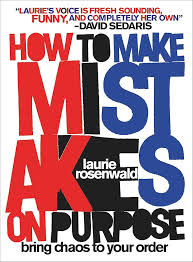
How to Make Mistakes on Purpose: Bring Chaos to Your Order by Laurie Rosenwald
Three generations of humans have now been molded into results-oriented workers who cannot mess up, and therefore may never innovate either. Shared software, skills, and experiences equal no surprises. Surrounded by the unwavering, reliable results made possible by a machine, we all marinate in this ubiquitous cybersauce. Behold! Thousands of shiny new apps, sites, products, and services that look, feel, and are essentially the same. Because computers don’t make mistakes.
Chance is the natural foil to the digital. We combine both for originality. This makes for the kind of exciting, hopeful future we want. We embrace technology but need to slap it around a bit to get someplace new.
Human error sparks connections. In a relaxed situation where one’s hypercritical demons are AWOL, the snap, crackle, pop of brainstorms happen all around us.
A fresh, colorful guide to discovery, with clearly marked directions and witty prompts, this is a book about living a productive, individualistic life. Whatever your job, it gives you a way to zig while everyone around you can only zag. It will also make you laugh along the way.
E-book available from USU Libraries
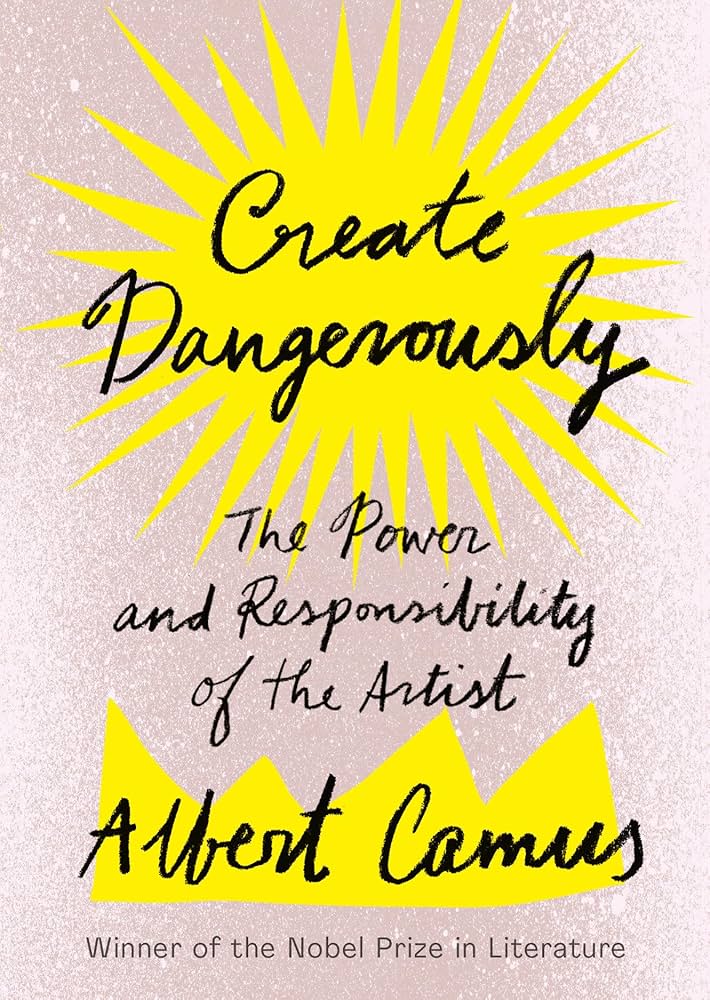
Create Dangerously: The Power and Responsibility of the Artist by Albert Camus
A call to arms for artists, in particular those who came from an immigrant background, like he did. • “To create today means to create dangerously. Every publication is a deliberate act, and that act makes us vulnerable to the passions of a century that forgives nothing.”
In 1957, Nobel Prize-winning philosopher Albert Camus gave a speech entitled "Create Dangerously." Camus understood the necessity of those making art as a part of civil society. A bold cry for artistic freedom and responsibility, his words today remain as timely as ever. In this new translation, Camus's message, available as a stand-alone little book for the first time, will resonate with a new generation of writers and artists.
E-book available from USU Libraries
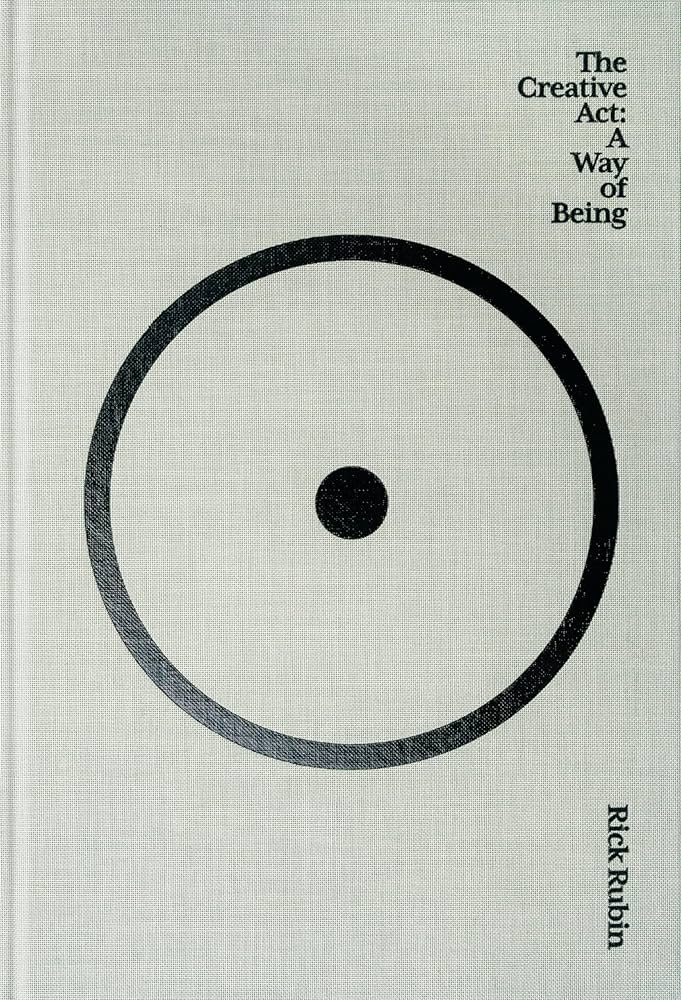
The Creative Act by Rick Rubin
Many famed music producers are known for a particular sound that has its day. Rick Rubin is known for something else: creating a space where artists of all different genres and traditions can home in on who they really are and what they really offer. He has made a practice of helping people transcend their self-imposed expectations in order to reconnect with a state of innocence from which the surprising becomes inevitable. Over the years, as he has thought deeply about where creativity comes from and where it doesn’t, he has learned that being an artist isn’t about your specific output, it’s about your relationship to the world. Creativity has a place in everyone’s life, and everyone can make that place larger. In fact, there are few more important responsibilities.
The Creative Act is a beautiful and generous course of study that illuminates the path of the artist as a road we all can follow. It distills the wisdom gleaned from a lifetime’s work into a luminous reading experience that puts the power to create moments—and lifetimes—of exhilaration and transcendence within closer reach for all of us.
Link to publisher's page.

The Age of Creativity: Art, Memory, My Father, and Me by Emily Urquhart
The Age of Creativity is a graceful, intimate blend of research on ageing and creativity, including on progressive senior-led organizations, such as a home for elderly theatre performers and a gallery in New York City that only represents artists over sixty, and her experiences living and travelling with her father. Emily Urquhart reveals how creative work, both amateur and professional, sustains people in the third act of their lives, and tells a new story about the possibilities of elder-hood.

Bird by Bird: Some Instructions on Writing and Life by Anne Lamott
For a quarter century, more than a million readers—scribes and scribblers of all ages and abilities—have been inspired by Anne Lamott’s hilarious, big-hearted, homespun advice. Advice that begins with the simple words of wisdom passed down from Anne’s father—also a writer—in the iconic passage that gives the book its title:
“Thirty years ago my older brother, who was ten years old at the time, was trying to get a report on birds written that he’d had three months to write. It was due the next day. We were out at our family cabin in Bolinas, and he was at the kitchen table close to tears, surrounded by binder paper and pencils and unopened books on birds, immobilized by the hugeness of the task ahead. Then my father sat down beside him, put his arm around my brother’s shoulder, and said, ‘Bird by bird, buddy. Just take it bird by bird.’”

Deep Affinities: Art and Science by Philip F. Palmedo
An illustrated exploration of the fundamental connections between art and science, from an author who has lived in both worlds
In this thought-provoking book, Philip F. Palmedo, a former physicist who now writes on art, reveals how the two defining enterprises of humankind―art and science―are rooted in certain common instincts, which we might call aesthetic: an appreciation of symmetry, balance, and rhythm; the drive to simplify and abstract natural forms, and to represent them symbolically.

Old Enough: Southern Women Artists and Writers on Creativity and Aging by Jay Lamar and Jennifer Horne
In Old Enough, twenty-one women artists and writers write about the experience of aging. Gay, straight, unmarried, partnered, widowed, Black, white, Latinx, retired, and working, these women are not squeamish about the challenges of growing older, including ageism, health concerns, and loss. And they are frank about how received notions of female aging can be restrictive and diminishing. But in lyrical, sometimes wry, often inspiring essays they explore what growing older can offer: self-knowledge, insight, and acceptance. Striking portraits by award-winning photographer Carolyn Sherer, who is also a contributor to the volume, accompany each essay.

Re-imagining Social Work: Towards Creative Practice by Jim Ife, Rimple Mehta, and Sharlotte Tusasiirwe
Social workers are increasingly faced with contemporary global challenges such as inequality, climate change and displacement of people. As a field committed to supporting the world's most vulnerable populations and communities, social work must adapt to meet the needs of this changing global landscape. Re-imagining Social Work broadens the imaginative horizons for social workers and acquaints readers with their potential to creatively contribute to global change. Written in an accessible style, this book motivates readers to think outside the box when it comes to linking theory to their social work practice, in order to construct innovative solutions to prominent social problems. Re-imagining Social Work provides a unique perspective on how social work can evolve for the future. Through theory and critical perspective, this book provides the skills required to be an innovative creative social worker.

The Work of Enchantment by Matthew Del Nevo
The Work of Enchantment suggests that it is a lack of "enchantment" in rich, developed countries that causes soul-starved Westerners to experience mental (and sometimes physical) illness. Del Nevo argues that this "enchantment" is most often experienced in childhood, but can also be found in adulthood, particularly through art. However, adults must cultivate within themselves the ability to appreciate art by reading, listening, and gazing-activities often misconceived in advanced industrial societies. Del Nevo describes the framework of enchantment and its philosophical and historical roots. He then concentrates on the work of enchantment within literature, considering what enchantment might entail taking the works of Proust, Rilke, and Goethe as examples. Del Nevo shows how a sense of enchantment forms within and between art works, using his literary examples, as well as between the work and the audience. The reader will learn along the way that enchantment may be found in the power of words, as an expression of the desire of the soul, a compliment of melancholy, and in art that points to something beyond itself. Enchantment may be found in many places, ranging from philosophy, religion, and psychology to sociology and culture, but here Del Nevo focuses on literature. His audience is people who are searching for something beyond money or glamour-perhaps the meaning of art and culture. His focus on literary masterpieces such as the Duino Elegies, Remembrance of Things Past, Wilhelm Meister's Journeyman Years, and others will make it of interest to those in cultural studies. Well written and engaging, and accessible to non-specialist readers, this unusual work in philosophy and aesthetics is free of jargon and complicated verbiage. Inspiring and enlivening, it is, in the author's words, "a stirring call to idleness."